

TradeTrust Newsletter March 2026

As part of the recent live Digital Documents against Payment (D/P) transaction, CNMC International Trading Co. Ltd. (CNIT), the trading and marketing center of China Nonferrous Metal Mining (Group) Co. Ltd., played a key role in demonstrating how interoperable electronic Bills of Lading (eBLs) can move seamlessly across digital platforms in a real trade environment.
As a leading global commodity trader operating across multiple jurisdictions and counterparties, CNIT recognises that digital transformation is not just about adopting electronic documents — it is about ensuring those documents can move securely and reliably across different platforms. Through its participation in the D/P transaction enabled by TradeTrust, CNIT showcased how cross-platform interoperability strengthens operational resilience, enhances trust between trading partners, and reduces dependency on any single platform provider.
In this edition, we hear from CNIT on how digital trade transformation aligns with its broader corporate strategy, and why interoperability is a business imperative for scaling secure and seamless global trade.
How does digital trade transformation align with CNIT’s broader business strategy?
"Digital trade transformation is closely aligned with CNIT's broader strategy of strengthening its global trading capabilities and building a more efficient, resilient, and future-ready supply chain. As a company operating across multiple jurisdictions, markets, and counterparties, CNIT sees digitalisation not simply as a technology upgrade, but as an important step toward improving operational efficiency, enhancing control over cross-border trade processes, and supporting sustainable long-term growth.
The recent live Digital Documents against Payment (D/P) transaction involving the Africa-Singapore-China trade corridor reflects this strategic direction in a practical way. By replacing paper-based processes with interoperable electronic documentation through TradeTrust, CNIT was able to streamline document presentation and title transfer, reduce processing time, and improve the overall efficiency of trade execution.
Looking ahead, CNIT will continue to explore the use of eBLs, digital collections, and other trusted digital trade solutions enabled by TradeTrust as part of its broader effort to build a secure, transparent, and efficient cross-border trading ecosystem.
数码贸易转型与中色国贸提升其全球贸易能力、打造更高效、更具韧性且面向未来的供应链这一整体战略一致。作为一家业务横跨多个司法辖区、市场和合作伙伴的企业, 中色国贸认为, 数码化不仅是技术层面的升级,更是提升运营效率、加强跨境贸易流程管控、支撑长期可持续发展的重要举措。
此次“非洲—新加坡—中国”贸易走廊下完成的数码化托收实单交易,正是这一战略方向的具体体现。通过TradeTrust以可互操作的电子单据替代传统纸质流程,中色国贸实现了单据提交和货权转移流程的优化, 缩短了处理时间,提升了整体贸易执行效率。"
展望未来, 中色国贸将继续探索电子提单、数码托收及其他由TradeTrust支持的可信数码贸易解决方案的应用, 持续推动建设安全、透明、高效的跨境贸易生态体系。
From a risk management perspective, how does the interoperability that TradeTrust provides reduce dependency on any one system or provider?
In cross-border commodity trading, where multiple parties need to exchange, verify, and act on trade documents across different systems, dependence on a single platform or provider can create concentration risk, limit flexibility, and affect business continuity.
TradeTrust helps address this by enabling trusted interoperability across platforms. For CNIT, this is important not only from an efficiency standpoint, but also from a governance and resilience perspective. It allows participants across the trade chain to engage using compatible systems, reduces the risk of operational bottlenecks caused by platform dependency, and strengthens confidence that digital processes can continue reliably even as trade ecosystems evolve.
In the recent D/P transaction, this interoperability allowed different parties to verify document authenticity and complete title transfer through trusted digital mechanisms. This helped improve both security and efficiency, while also demonstrating how open and interoperable digital infrastructure can support more resilient cross-border trade.
在跨境大宗商品贸易中, 多个参与方需要在不同系统之间交换、核验并处理贸易单据, 如果过度依赖单一平台或服务提供商, 就容易带来集中度风险, 限制业务灵活性, 并影响业务连续性。
TradeTrust 所支持的互操作机制,正是在这一点上发挥了重要作用。对中色国贸而言, 这不仅意味着效率提升, 更意味着在治理和韧性层面获得了更强保障。它使贸易链条上的参与方能够基于兼容系统开展协作, 减少因平台依赖带来的操作瓶颈, 并增强各方对数码化流程持续稳定运行的信心。
在此次数码化托收实单交易中, 互操作性支持各参与方通过可信的数码机制完成单据真实性核验和货权转移。这不仅提升了交易安全性和处理效率, 也展示了开放、互通的数码基础设施如何支持更坚韧的跨境贸易。
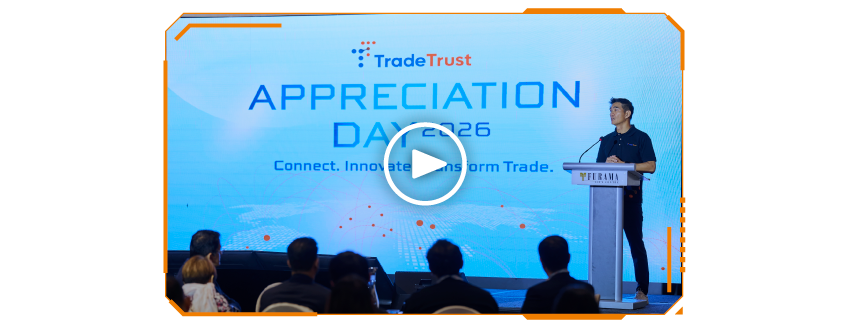
Collaboration remains critical in an increasingly interconnected world. With Interoperability as this year’s theme, TradeTrust Appreciation Day, held on 4 February 2026, brought together industry leaders and partners to reaffirm our shared commitment to strengthening digital trust and infrastructure for global trade.
The event featured perspectives from distinguished guest speakers and thought leaders who shared insights on advancing cross-platform data exchange. An interoperability demonstration showcased how electronic Bills of Lading (eBLs) can be transferred seamlessly across TradeTrust-enabled platforms, moving beyond pilots towards real-world implementation.
We also marked key milestones in TradeTrust’s journey:
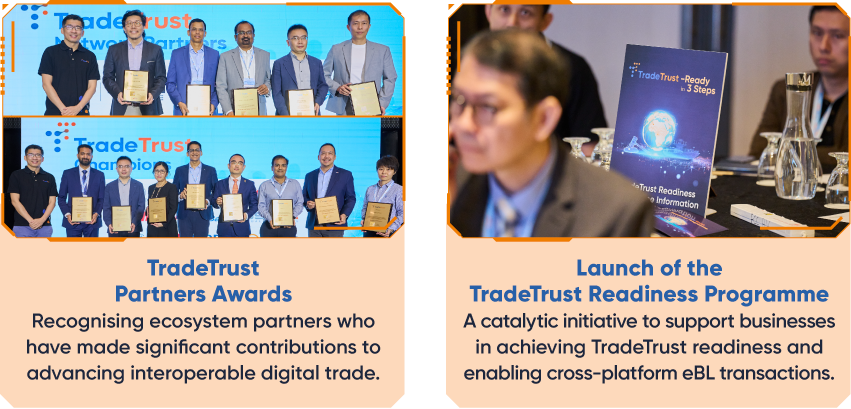
As interoperable systems transition from experimentation to live adoption, TradeTrust will continue working closely with industry and government partners to accelerate the exchange of trusted digital documents across borders.
Thank you to all our speakers, partners, and attendees who made the event a success. Your continued collaboration is helping to build an open, trusted, and connected digital trade ecosystem.
In case you missed the event, watch our post-event video:
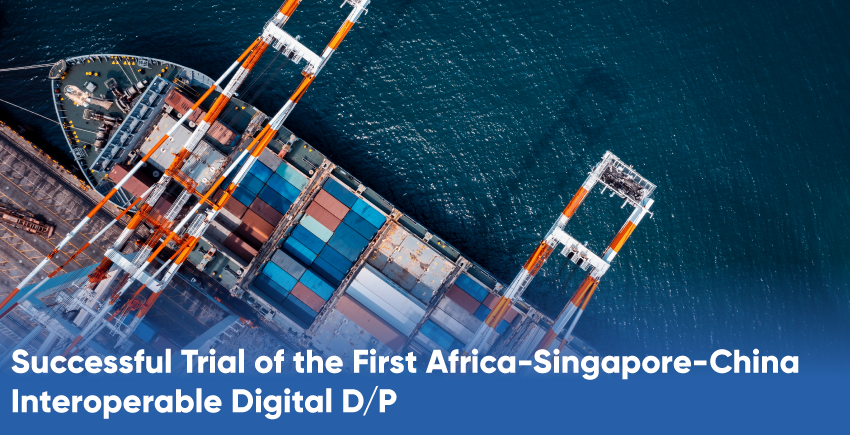
On 20 January 2026, the first Africa-Singapore-China bulk commodity import transaction using end-to-end interoperable Digital Documents against Payment (D/P) was successfully completed.
The project was jointly promoted by the Beijing Two-Zone Office and supported by Singapore’s Infocomm Media Development Authority (IMDA), marking another milestone in Beijing-Singapore digital economy collaboration.
The live transaction involved:
-
CNMC International Trading Co. Ltd. (CNIT), the trading and marketing center of China Nonferrous Metal Mining (Group) Co. Ltd., and Jiangxi Copper Company Limited as trading parties;
-
Pacific International Lines (PIL) issuing an electronic Bill of Lading (eBL);
-
DBS Bank and OCBC Bank acting as remitting banks; and
-
Bank of China (Jiangxi Branch) serving as the collecting bank.
The shipment of anode copper (valued at USD 5 million) was carried out by CNIT and Jiangxi Copper Company Limited, travelling from Durban, South Africa, to Ningbo, China, with the eBL issued via AEOTradeChain integrated with TradeTrust.
This project achieved three major breakthroughs:
1. The first end-to-end interoperable Digital D/P for bulk commodities
An end-to-end digital workflow covering document circulation and payment settlement — reducing title transfer time from 20 days to 5 days, and BL processing time from 10 days to 5 minutes.
2. Trial in a cross-regional integration model
A “China-Singapore cooperation + South African scenario” enabling secure data exchange across different digital trade systems.
3. Interoperable digital trade finance in action
Banks were able to verify documents directly on the platform - improving efficiency, reducing fraud risk, and lowering operational costs.
Participating enterprises reported:
-
93% reduction in document error rates;
-
Elimination of courier costs; and
-
Faster and more secure cross-border settlement.
This milestone reinforced the role of interoperable digital trade documents in enabling real-world, cross-border trade finance.

From now until 30 April 2026, applications for the TradeTrust Readiness Programme are open for Digital Trade Platform (DTP) and Carrier pairs. The programme, supported by Singapore’s Infocomm Media Development Authority (IMDA), will run until 31 March 2027.
Through the programme, TradeTrust brings together DTPs and Carriers to integrate the TradeTrust framework and demonstrate live, cross-platform interoperability for electronic Bills of Lading (eBLs).
Why this programme matters
While the adoption of eBLs is growing, the industry continues to face key challenges:
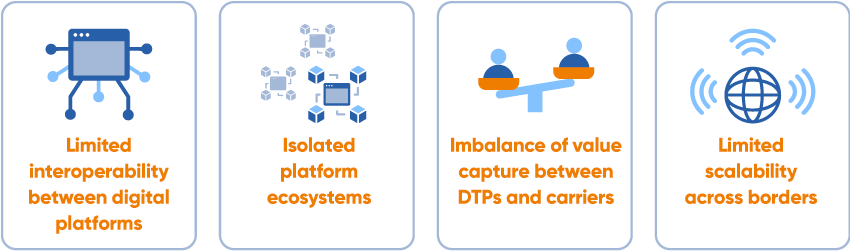
The TradeTrust Readiness Programme directly addresses these gaps by enabling DTP-Carrier pairs to demonstrate title transfer interoperability, legal compliance, including alignment with the Model Law on Electronic Transferable Records (MLETR), and real-world cross-platform transactions.
Selected DTP-Carrier pairs will receive S$80,000 in funding upon successful completion of key milestones, including:

Be part of the open, interoperable eBL network. Move beyond siloed systems and demonstrate interoperability across the maritime ecosystem.

Tech Updates

What was previously known as TradeTrust Libraries is now TrustVC. With this rebranding, platform providers and integrators will find clearer documentation, stronger W3C Verifiable Credentials (VC) alignment, and a more streamlined path to new features.
What this means for you
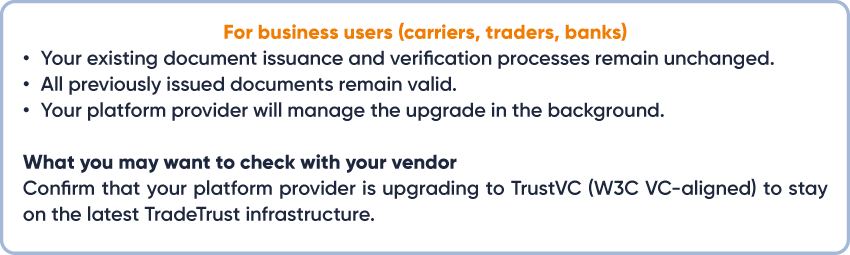
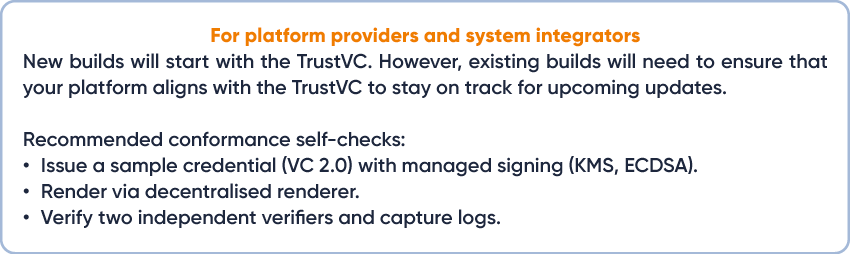
What stays the same
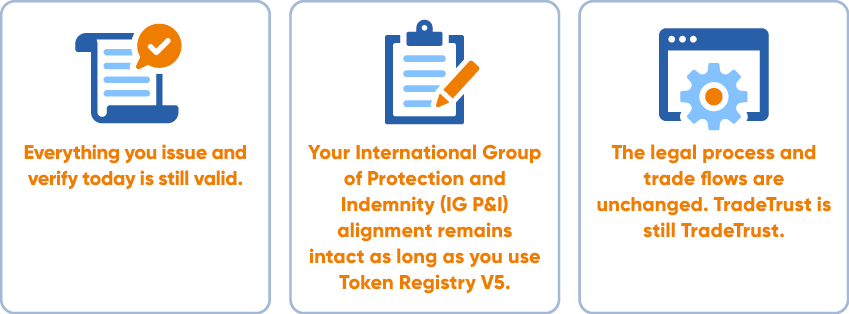
Why the change
TradeTrust’s underlying libraries have evolved into a broader toolkit used for document attestation beyond trade. The rebrand to TrustVC clarifies its role as the technology engine behind TradeTrust, while aligning it more closely with W3C VC standards. This enables vendors to build one system and interoperate across industries, while TradeTrust continues to focus on trade-specific legal and operational frameworks.
Improvements with TrustVC
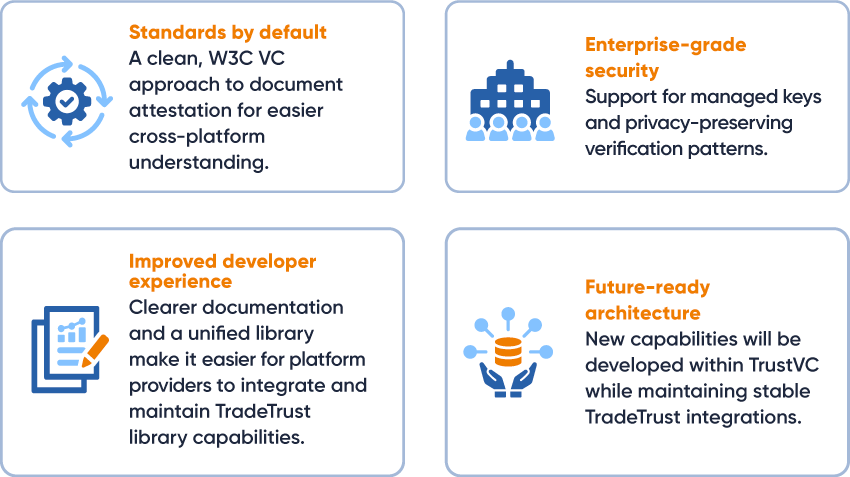
This update ensures TradeTrust continues to evolve on a standards-aligned foundation while maintaining stability for the businesses that rely on it.

About TradeTrust
|
|
|---|